Exclusive
To get our best deals and discounts Subscribe Below!
Continue As A Guest
Continue As A Guest
Updata
Hey! Thank you so much for your support and quality posts for V Show!
And congratulations on becoming our Vipon Associated Editor.
From now on, in addition to getting 10 points for each post (up to 30 points daily), we will regularly review each of your articles, and each approved article (tagged with Featured label) will be paid an additional $50.
Note: Not all articles you posted will get $50, only those that meet our requirements will be paid, and articles or contents that do not meet the requirements will be removed.
Please continue to produce high quality content for organic likes. Our shoppers love seeing your stories & posts!
Congratulations! Your V SHOW post Planting Tips has become our Featured content, we will pay $50 for this post. Please check on your balance. Please continue to produce high quality original content!
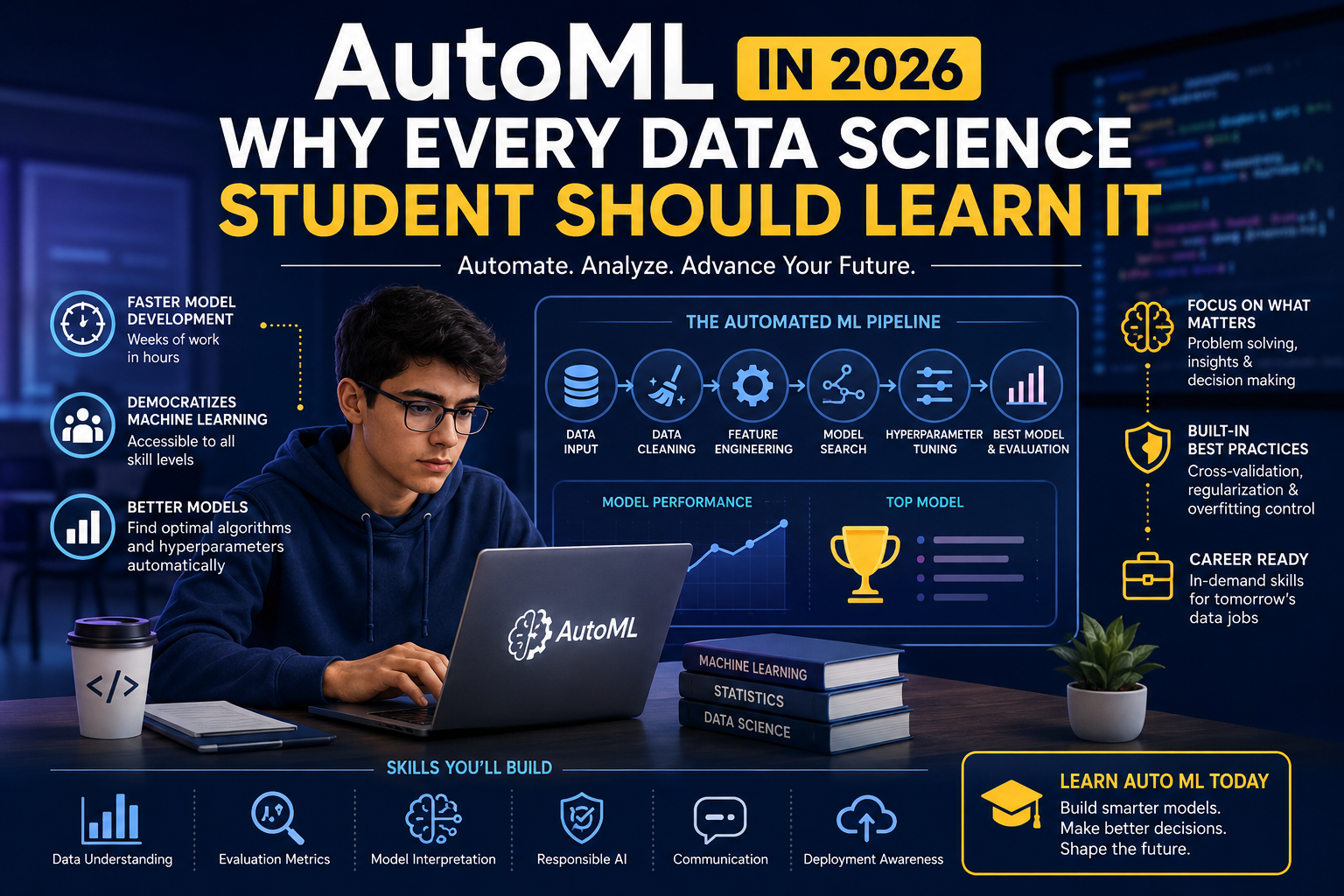
Machine learning education is evolving faster than ever. Students once spent entire semesters building models from scratch, testing dozens of algorithms, and manually tuning hyperparameters. Today, AutoML platforms can automate much of that work in just a few hours. The question many students ask is simple: Should I still learn traditional machine learning if AutoML can do most of the technical work?
The short answer is yes. AutoML is changing how machine learning is practiced, but it is not replacing the knowledge that makes great data scientists successful. Instead, it is shifting the emphasis from repetitive coding to better decision-making, stronger data analysis, and responsible AI development.
Traditional machine learning teaches students how algorithms actually work.
Learners write code to preprocess datasets, engineer features, split training and testing data, select algorithms, optimize hyperparameters, and evaluate performance. Every stage helps students understand why one model performs better than another.
Although this process takes time, it develops problem-solving skills that cannot be replaced by automation.
Students also gain experience identifying common issues such as overfitting, underfitting, data leakage, and class imbalance. These challenges appear in real business projects regardless of whether AutoML is being used.
Without this foundation, it becomes difficult to judge whether an automatically generated model can actually be trusted.
AutoML changes the workflow by automating repetitive technical tasks.
Instead of manually testing dozens of algorithms, the software evaluates multiple combinations automatically. It performs feature engineering, hyperparameter optimization, model comparison, and ranking with minimal user intervention.
This dramatically reduces development time.
A project that once required several days of experimentation can often produce strong baseline results within a few hours. That speed allows students to focus on interpreting outcomes rather than repeatedly rewriting code.
AutoML does not eliminate learning. It removes routine tasks so students can spend more time understanding the business problem.
The largest difference between AutoML and traditional machine learning is not technology.
It is responsibility.
AutoML can recommend the highest-scoring model, but it cannot determine whether the data represents reality, whether the chosen metric matches the business objective, or whether hidden bias exists within the dataset.
Imagine hiring a highly experienced chef with the world's best kitchen equipment. The chef can prepare an outstanding meal, but if the ingredients are spoiled, the final dish will still disappoint.
AutoML operates the same way.
Good data produces good results. Poor data produces poor predictions regardless of how advanced the automation becomes.
Employers increasingly expect graduates to understand both manual machine learning techniques and automated platforms.
Traditional machine learning demonstrates technical depth.
AutoML demonstrates productivity.
Together, these skills prepare graduates for modern AI teams where rapid experimentation is just as valuable as technical expertise.
Students should understand evaluation metrics such as accuracy, precision, recall, F1-score, AUC, and RMSE. They also need to interpret feature importance, validate model performance, and explain predictions to non-technical stakeholders. These abilities remain essential even when AutoML generates the models automatically.
Students entering the AI industry should become familiar with several widely used AutoML tools.
Auto-Sklearn extends the Scikit-learn ecosystem by automatically selecting and tuning machine learning models.
TPOT uses evolutionary algorithms to discover efficient pipelines.
H2O AutoML supports enterprise-level machine learning while providing production-ready deployment options.
AutoGluon simplifies work with structured datasets, images, and text.
Cloud solutions such as Google Vertex AI AutoML and Azure Automated ML make machine learning accessible through visual interfaces, making them especially useful for beginners and business analytics students.
Learning both open-source libraries and cloud platforms gives students practical experience that aligns with industry expectations.
When assignments involve comparing AutoML frameworks, evaluating leaderboards, or documenting model performance, Expertsmind.com's subject expert network can help students understand the reasoning behind automated decisions while improving project quality.
Businesses are adopting AutoML because it accelerates development, not because it replaces professionals.
Organizations still need people who understand data quality, model governance, fairness, privacy, explainability, and deployment strategies.
Healthcare companies require transparent prediction systems.
Banks must justify automated lending decisions.
Retail businesses need reliable demand forecasting models.
Every industry depends on professionals who can evaluate automated outputs before those predictions influence real decisions.
Students who combine technical knowledge with communication skills and critical thinking are becoming the strongest candidates for AI and data science roles.
The debate between AutoML and traditional machine learning is not about choosing one over the other.
The most successful professionals understand both.
Traditional machine learning teaches why models work. AutoML shows how to build them faster. Together, they create a balanced skill set that matches the needs of modern organizations.
As AutoML continues to evolve throughout 2026 and beyond, students who master machine learning fundamentals while embracing intelligent automation will be well prepared for the next generation of AI careers.
Machine learning education is evolving faster than ever. Students once spent entire semesters building models from scratch, testing dozens of algorithms, and manually tuning hyperparameters. Today, AutoML platforms can automate much of that work in just a few hours. The question many students ask is simple: Should I still learn traditional machine learning if AutoML can do most of the technical work?
The short answer is yes. AutoML is changing how machine learning is practiced, but it is not replacing the knowledge that makes great data scientists successful. Instead, it is shifting the emphasis from repetitive coding to better decision-making, stronger data analysis, and responsible AI development.
Traditional machine learning teaches students how algorithms actually work.
Learners write code to preprocess datasets, engineer features, split training and testing data, select algorithms, optimize hyperparameters, and evaluate performance. Every stage helps students understand why one model performs better than another.
Although this process takes time, it develops problem-solving skills that cannot be replaced by automation.
Students also gain experience identifying common issues such as overfitting, underfitting, data leakage, and class imbalance. These challenges appear in real business projects regardless of whether AutoML is being used.
Without this foundation, it becomes difficult to judge whether an automatically generated model can actually be trusted.
AutoML changes the workflow by automating repetitive technical tasks.
Instead of manually testing dozens of algorithms, the software evaluates multiple combinations automatically. It performs feature engineering, hyperparameter optimization, model comparison, and ranking with minimal user intervention.
This dramatically reduces development time.
A project that once required several days of experimentation can often produce strong baseline results within a few hours. That speed allows students to focus on interpreting outcomes rather than repeatedly rewriting code.
AutoML does not eliminate learning. It removes routine tasks so students can spend more time understanding the business problem.
The largest difference between AutoML and traditional machine learning is not technology.
It is responsibility.
AutoML can recommend the highest-scoring model, but it cannot determine whether the data represents reality, whether the chosen metric matches the business objective, or whether hidden bias exists within the dataset.
Imagine hiring a highly experienced chef with the world's best kitchen equipment. The chef can prepare an outstanding meal, but if the ingredients are spoiled, the final dish will still disappoint.
AutoML operates the same way.
Good data produces good results. Poor data produces poor predictions regardless of how advanced the automation becomes.
Employers increasingly expect graduates to understand both manual machine learning techniques and automated platforms.
Traditional machine learning demonstrates technical depth.
AutoML demonstrates productivity.
Together, these skills prepare graduates for modern AI teams where rapid experimentation is just as valuable as technical expertise.
Students should understand evaluation metrics such as accuracy, precision, recall, F1-score, AUC, and RMSE. They also need to interpret feature importance, validate model performance, and explain predictions to non-technical stakeholders. These abilities remain essential even when AutoML generates the models automatically.
Students entering the AI industry should become familiar with several widely used AutoML tools.
Auto-Sklearn extends the Scikit-learn ecosystem by automatically selecting and tuning machine learning models.
TPOT uses evolutionary algorithms to discover efficient pipelines.
H2O AutoML supports enterprise-level machine learning while providing production-ready deployment options.
AutoGluon simplifies work with structured datasets, images, and text.
Cloud solutions such as Google Vertex AI AutoML and Azure Automated ML make machine learning accessible through visual interfaces, making them especially useful for beginners and business analytics students.
Learning both open-source libraries and cloud platforms gives students practical experience that aligns with industry expectations.
When assignments involve comparing AutoML frameworks, evaluating leaderboards, or documenting model performance, Expertsmind.com's subject expert network can help students understand the reasoning behind automated decisions while improving project quality.
Businesses are adopting AutoML because it accelerates development, not because it replaces professionals.
Organizations still need people who understand data quality, model governance, fairness, privacy, explainability, and deployment strategies.
Healthcare companies require transparent prediction systems.
Banks must justify automated lending decisions.
Retail businesses need reliable demand forecasting models.
Every industry depends on professionals who can evaluate automated outputs before those predictions influence real decisions.
Students who combine technical knowledge with communication skills and critical thinking are becoming the strongest candidates for AI and data science roles.
The debate between AutoML and traditional machine learning is not about choosing one over the other.
The most successful professionals understand both.
Traditional machine learning teaches why models work. AutoML shows how to build them faster. Together, they create a balanced skill set that matches the needs of modern organizations.
As AutoML continues to evolve throughout 2026 and beyond, students who master machine learning fundamentals while embracing intelligent automation will be well prepared for the next generation of AI careers.
Are you sure you want to stop following?
Loading…
Congrats! You are now a member!
Start requesting vouchers for promo codes by clicking the Request Deal buttons on products you want.
Sellers of Amazon products are required to sign in at www.amztracker.com
More information about placing your products on this site can be found here.
Are you having problems purchasing a product with the supplied voucher? If so, please contact the seller via the supplied email.
Also, please be patient. Sellers are pretty busy people and it can take awhile to respond to your emails.
After 2 days of receiving a voucher you can report the seller to us (using the same button) if you cannot resolve this issue with the seller.
For more information click here.
We have taken note and will also convey the problems to the seller on your behalf.
Usually the seller will rectify it soon, we suggest now you can remove this request from your dashboard and choose another deal.
If you love this deal most, we suggest you can try to request this deal after 2 days.
This will mark the product as purchased. The voucher will be permanently removed from your dashboard shortly after. Are you sure?
You are essentially competing with a whole lot of other buyers when requesting to purchase a product. The seller only has a limited amount of vouchers to give out too.
Select All Groups
✕
Adult Products
Arts, Crafts & Sewing
Automotive & Industrial
Beauty & Grooming
Cell Phones & Accessories
Electronics & Office
Health & Household
Home & Garden
Jewelry
Kitchen & Dining
Men's Clothing & Shoes
Pet Supplies
Sports & Outdoors
Toys, Kids & Baby
Watches
Women's Clothing & Shoes
Other
Adult Products
©Copyright 2026 Vipon All Right Reserved · Privacy Policy · Terms of Service · Do Not Sell My Personal Information
Certain content in this page comes from Amazon. The content is provided as is, and is subject
to change or removal at
any time. Amazon and the Amazon logo are trademarks of Amazon.com,
Inc. or its affiliates.
Comments