Exclusive
To get our best deals and discounts Subscribe Below!
Continue As A Guest
Continue As A Guest
Updata
Hey! Thank you so much for your support and quality posts for V Show!
And congratulations on becoming our Vipon Associated Editor.
From now on, in addition to getting 10 points for each post (up to 30 points daily), we will regularly review each of your articles, and each approved article (tagged with Featured label) will be paid an additional $50.
Note: Not all articles you posted will get $50, only those that meet our requirements will be paid, and articles or contents that do not meet the requirements will be removed.
Please continue to produce high quality content for organic likes. Our shoppers love seeing your stories & posts!
Congratulations! Your V SHOW post Planting Tips has become our Featured content, we will pay $50 for this post. Please check on your balance. Please continue to produce high quality original content!
Professional painting contractors don’t rely on guesswork when it comes to equipment care. A paint sprayer is one of the most expensive and important tools on any job site, and poor maintenance quickly leads to breakdowns, uneven finishes, and lost income. That’s why experienced professionals stick to a paint sprayer maintenance schedule contractors actually follow—a realistic routine that works in day-to-day conditions, not just in manuals.
Why Maintenance Is Non-Negotiable for Contractors
Paint sprayers operate under high pressure and tight tolerances. Even a small amount of dried paint or air leakage can cause major problems. Contractors understand that regular maintenance prevents:
Inconsistent spray patterns
Sudden pressure drops
Costly part replacements
Job delays and unhappy clients
Daily Maintenance: What Pros Never Skip
No matter how busy the job is, professional painters always handle these tasks at the end of the day.
Paint should never be left inside the system overnight. Contractors flush the sprayer immediately after use:
Water for latex and water-based paints
Mineral spirits or an approved solvent for oil-based coatings
They continue flushing until the fluid runs completely clear. This single habit prevents most pump and hose failures.
Spray tips clog easily and directly affect finish quality. Contractors remove the tip, guard, and gun filter daily and clean them with a soft brush. This avoids tails, spitting, and uneven coverage.
A quick wipe-down removes overspray and dust that can block cooling vents or hide leaks. It also makes it easier to spot issues early.
Weekly Maintenance: Preventing Mid-Job Failures
Weekly checks are where experienced contractors stay ahead of problems.
Most professional sprayers have multiple filters, including inlet, manifold, and gun filters. Contractors clean or replace these weekly to maintain steady pressure and flow.
High-pressure hoses are inspected for soft spots, cracks, and leaks. Loose fittings are tightened carefully, not over-tightened. A failed hose can stop a job instantly and create safety risks.
Contractors regularly apply throat seal liquid or pump lubricant to keep packings from drying out. This small step significantly extends pump life.
Monthly Maintenance: The Difference Between Pros and Beginners
Monthly maintenance is often skipped by inexperienced users, but professionals know its value.
Worn packings cause leaks, pressure loss, and pump damage. Contractors inspect these parts monthly and plan rebuilds before complete failure.
Stable pressure is essential for a consistent finish. Contractors check that the sprayer builds pressure smoothly and holds it without fluctuation.
For electric units, cords and switches are inspected. For pneumatic systems, moisture traps and regulators are checked. Small issues here can shut down a job completely.
Seasonal Maintenance Contractors Rely On
The paint sprayer maintenance schedule contractors actually follow changes slightly with the seasons.
Contractors prepare sprayers by replacing worn tips, checking hoses, and servicing pumps. This prevents breakdowns during peak work periods.
Before long-term storage, professionals fully flush the system, run the pump protector or storage fluid, and store the sprayer in a dry, temperature-stable environment. Improper storage is a common cause of spring startup problems.
Maintenance Based on Sprayer Type
Different sprayers require slightly different care routines.
Contractors using equipment from manufacturers like Graco focus heavily on pump packings, pressure controls, and high-pressure hoses due to the extreme operating pressures.
With HVLP systems from brands such as Wagner, airflow is critical. Contractors regularly clean turbine filters, air hoses, and nozzles to maintain performance.
Compressed-air systems require frequent moisture control. Professionals drain air compressors, check regulators, and maintain oilers to prevent finish defects.
Parts Contractors Replace Proactively
Rather than waiting for failure, experienced painters replace certain components on a schedule:
Spray tips after 40–60 gallons
Gun and manifold filters are regularly
Pump packings are annually used for heavy use
Hoses at the first sign of wear
This proactive approach reduces downtime and emergency repairs.
Common Maintenance Mistakes Professionals Avoid
Contractors with years of experience avoid mistakes that shorten equipment life:
Leaving paint in the sprayer overnight
Using the wrong solvent
Ignoring small leaks
Running clogged filters
Over-tightening fittings
Avoiding these habits saves both time and money.
A Simple Contractor-Approved Maintenance Routine
Here’s a realistic summary of the paint sprayer maintenance schedule contractors actually follow:
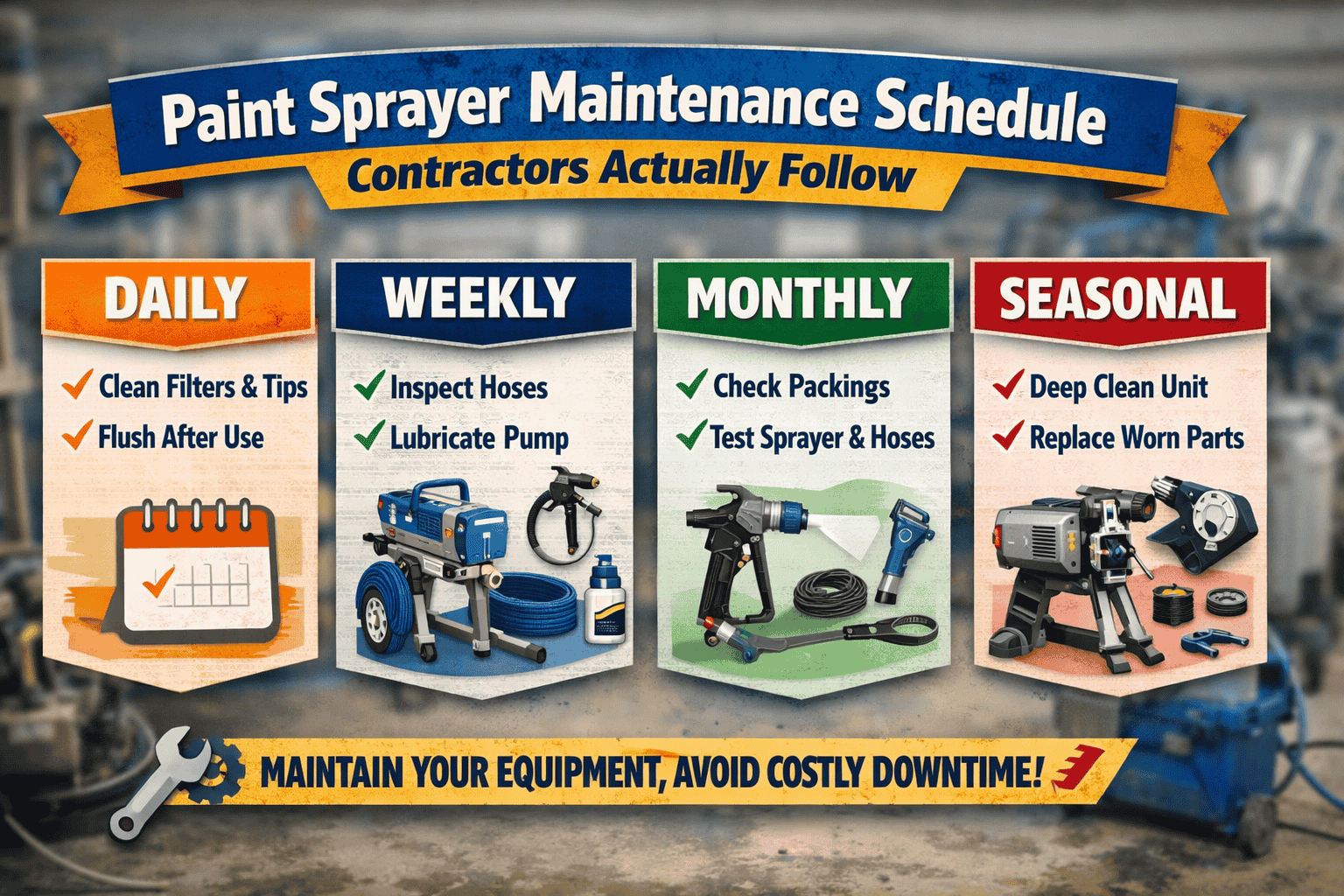
Daily: Flush the system, clean the spray tip and gun, wipe down the unit.
Weekly: Clean filters, inspect hoses, lubricate the pump.
Monthly: Inspect packings, test pressure control, check electrical or air components.
Seasonal: Perform pre-season servicing and proper end-of-season storage.
Final Thoughts
Professional painters don’t overcomplicate maintenance—but they never ignore it. The paint sprayer maintenance schedule contractors actually follow is built around real jobsite demands: fast, practical, and effective.
By following this routine, you’ll get smoother finishes, fewer breakdowns, and a longer lifespan from your equipment. In the long run, consistent maintenance isn’t extra work—it’s how professionals protect their business and reputation.
Professional painting contractors don’t rely on guesswork when it comes to equipment care. A paint sprayer is one of the most expensive and important tools on any job site, and poor maintenance quickly leads to breakdowns, uneven finishes, and lost income. That’s why experienced professionals stick to a paint sprayer maintenance schedule contractors actually follow—a realistic routine that works in day-to-day conditions, not just in manuals.
Why Maintenance Is Non-Negotiable for Contractors
Paint sprayers operate under high pressure and tight tolerances. Even a small amount of dried paint or air leakage can cause major problems. Contractors understand that regular maintenance prevents:
Inconsistent spray patterns
Sudden pressure drops
Costly part replacements
Job delays and unhappy clients
Daily Maintenance: What Pros Never Skip
No matter how busy the job is, professional painters always handle these tasks at the end of the day.
Paint should never be left inside the system overnight. Contractors flush the sprayer immediately after use:
Water for latex and water-based paints
Mineral spirits or an approved solvent for oil-based coatings
They continue flushing until the fluid runs completely clear. This single habit prevents most pump and hose failures.
Spray tips clog easily and directly affect finish quality. Contractors remove the tip, guard, and gun filter daily and clean them with a soft brush. This avoids tails, spitting, and uneven coverage.
A quick wipe-down removes overspray and dust that can block cooling vents or hide leaks. It also makes it easier to spot issues early.
Weekly Maintenance: Preventing Mid-Job Failures
Weekly checks are where experienced contractors stay ahead of problems.
Most professional sprayers have multiple filters, including inlet, manifold, and gun filters. Contractors clean or replace these weekly to maintain steady pressure and flow.
High-pressure hoses are inspected for soft spots, cracks, and leaks. Loose fittings are tightened carefully, not over-tightened. A failed hose can stop a job instantly and create safety risks.
Contractors regularly apply throat seal liquid or pump lubricant to keep packings from drying out. This small step significantly extends pump life.
Monthly Maintenance: The Difference Between Pros and Beginners
Monthly maintenance is often skipped by inexperienced users, but professionals know its value.
Worn packings cause leaks, pressure loss, and pump damage. Contractors inspect these parts monthly and plan rebuilds before complete failure.
Stable pressure is essential for a consistent finish. Contractors check that the sprayer builds pressure smoothly and holds it without fluctuation.
For electric units, cords and switches are inspected. For pneumatic systems, moisture traps and regulators are checked. Small issues here can shut down a job completely.
Seasonal Maintenance Contractors Rely On
The paint sprayer maintenance schedule contractors actually follow changes slightly with the seasons.
Contractors prepare sprayers by replacing worn tips, checking hoses, and servicing pumps. This prevents breakdowns during peak work periods.
Before long-term storage, professionals fully flush the system, run the pump protector or storage fluid, and store the sprayer in a dry, temperature-stable environment. Improper storage is a common cause of spring startup problems.
Maintenance Based on Sprayer Type
Different sprayers require slightly different care routines.
Contractors using equipment from manufacturers like Graco focus heavily on pump packings, pressure controls, and high-pressure hoses due to the extreme operating pressures.
With HVLP systems from brands such as Wagner, airflow is critical. Contractors regularly clean turbine filters, air hoses, and nozzles to maintain performance.
Compressed-air systems require frequent moisture control. Professionals drain air compressors, check regulators, and maintain oilers to prevent finish defects.
Parts Contractors Replace Proactively
Rather than waiting for failure, experienced painters replace certain components on a schedule:
Spray tips after 40–60 gallons
Gun and manifold filters are regularly
Pump packings are annually used for heavy use
Hoses at the first sign of wear
This proactive approach reduces downtime and emergency repairs.
Common Maintenance Mistakes Professionals Avoid
Contractors with years of experience avoid mistakes that shorten equipment life:
Leaving paint in the sprayer overnight
Using the wrong solvent
Ignoring small leaks
Running clogged filters
Over-tightening fittings
Avoiding these habits saves both time and money.
A Simple Contractor-Approved Maintenance Routine
Here’s a realistic summary of the paint sprayer maintenance schedule contractors actually follow:
Daily: Flush the system, clean the spray tip and gun, wipe down the unit.
Weekly: Clean filters, inspect hoses, lubricate the pump.
Monthly: Inspect packings, test pressure control, check electrical or air components.
Seasonal: Perform pre-season servicing and proper end-of-season storage.
Final Thoughts
Professional painters don’t overcomplicate maintenance—but they never ignore it. The paint sprayer maintenance schedule contractors actually follow is built around real jobsite demands: fast, practical, and effective.
By following this routine, you’ll get smoother finishes, fewer breakdowns, and a longer lifespan from your equipment. In the long run, consistent maintenance isn’t extra work—it’s how professionals protect their business and reputation.
Are you sure you want to stop following?
Loading…
Congrats! You are now a member!
Start requesting vouchers for promo codes by clicking the Request Deal buttons on products you want.
Sellers of Amazon products are required to sign in at www.amztracker.com
More information about placing your products on this site can be found here.
Are you having problems purchasing a product with the supplied voucher? If so, please contact the seller via the supplied email.
Also, please be patient. Sellers are pretty busy people and it can take awhile to respond to your emails.
After 2 days of receiving a voucher you can report the seller to us (using the same button) if you cannot resolve this issue with the seller.
For more information click here.
We have taken note and will also convey the problems to the seller on your behalf.
Usually the seller will rectify it soon, we suggest now you can remove this request from your dashboard and choose another deal.
If you love this deal most, we suggest you can try to request this deal after 2 days.
This will mark the product as purchased. The voucher will be permanently removed from your dashboard shortly after. Are you sure?
You are essentially competing with a whole lot of other buyers when requesting to purchase a product. The seller only has a limited amount of vouchers to give out too.
Select All Groups
✕
Adult Products
Arts, Crafts & Sewing
Automotive & Industrial
Beauty & Grooming
Cell Phones & Accessories
Electronics & Office
Health & Household
Home & Garden
Jewelry
Kitchen & Dining
Men's Clothing & Shoes
Pet Supplies
Sports & Outdoors
Toys, Kids & Baby
Watches
Women's Clothing & Shoes
Other
Adult Products
©Copyright 2026 Vipon All Right Reserved · Privacy Policy · Terms of Service · Do Not Sell My Personal Information
Certain content in this page comes from Amazon. The content is provided as is, and is subject
to change or removal at
any time. Amazon and the Amazon logo are trademarks of Amazon.com,
Inc. or its affiliates.
Comments